A young girl, seduced by a ribbon and the viciousness of a ribbon seller, transforms from a working class, charity-school girl to a hardened street walker in eighteenth-century England in Emma Donaghue's Slammerkin. The young girl, impregnated by the ribbon peddlar and consequently banished the home of her mother, develops a contradictory personality. She leeches onto women she meets and seeks their affection and praise. At the same time, she is manifestly incapable of conquering her wholly economic sense of self interest. As a result, women are always the worse for their encounters with young Mary Saunders.
Donaghue's book mines the archives for source material, as befitting the work of a novelist who is also a historian. I resist the label of historical fiction for this novel, however, as that generic title has come to denote a very specific kind of dramatic, sweeping, and painstakingly detailed story. In some respects, Slammerkin boasts more liveliness and deftness than many a "historical fiction," yet gives a lot of historical texture to the narrative that makes it unlike a contemporary tale.
For all that makes it a good read, I will quarrel with Slammerkin all the same. The book relentlessly follows Mary from her first ruin to the standard conclusion of a woman so sullied. A story like this requries the reader's absolute commitment to the protagonist, even if we don't like her--and Mary is very hard to like. The book fails, I think, in its ambition for complexity for the character. Instead of feeling rich and rounded and consistent, the character instead feels contradictory and motorless. We don't know why she makes the decision she does--they are inexplicable, especially the climactic one. Mary's life begins to feel like a game that leaves the reader's emotional involvement on the sidelines.
Wednesday
Monday
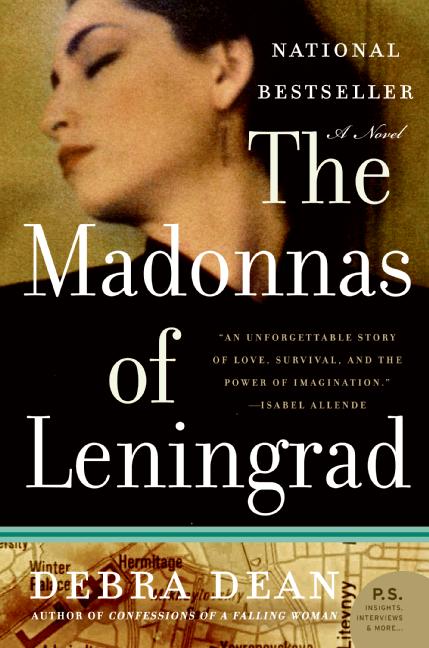
Reflections: The Madonnas of Leningrad
It's rare I take the time to savor a stumbled upon book. With a list of To Be Read that rivals the Eiffel tower in height, I have to be choosy. I was seduced by the vivid cover and compactness of Debra Dean's The Madonnas of Leningrad, and I'm glad for it.
It is not, it must be pointed out, an amazing piece of literature by any common standard. It does, however, offer the quiet pleasure of the picturesque. The story tacks back and forth between the siege of Leningrad and a wedding in Washington state. The reader follows the thoughts and memories of Marina who in her past was a tour guide and art protector at what we now call the Hermitage Museum in Leningrad and who in her present is experiencing the steep downhill of Alzheimer's affliction at her granddaughter's nuptials. What connects the two parts of this woman's life is her relationship to memory.
While suffering from a famine that is killing off the citizens of Leningrad after German bombs wipe out the city's food supply, Marina satisfies her need for pleasure by memorizing what used to be displayed in each room of her museum before the art was shipped off for safe keeping. She remembers the lush still lifes and the pious Madonnas, the stiff portraits and the international curios. Dean's writing, at its best, conveys the semi-hysterical ecstasy that the starving girl feels in the presence of the imagined art works. Each reconstructed brush stroke really does help Marina dull the pain of frozen digits, dying relatives, and a fiance missing on the front.
In her present-day life, Marina is warm and loved by the long-found fiance (now husband) and their two children. She doesn't ache for memories of artistic beauty to fill other needs. This stage of her life is about the (painful, real, harsh, yet ineffably exhilarating, too) truth that forgetting allows one to see beauty too. Marina can no longer identify with accuracy herself in a mirror or her family members around her. This forgetting enables her to disencumber herself of all associations and to just be in the world, to experience the green of a dappled light as though she never has before.
Madonnas is a book to give yourself over to for an afternoon (and that's all it will take). It will bring you on a sweet and short journey into a different life than the one you lead.
It is not, it must be pointed out, an amazing piece of literature by any common standard. It does, however, offer the quiet pleasure of the picturesque. The story tacks back and forth between the siege of Leningrad and a wedding in Washington state. The reader follows the thoughts and memories of Marina who in her past was a tour guide and art protector at what we now call the Hermitage Museum in Leningrad and who in her present is experiencing the steep downhill of Alzheimer's affliction at her granddaughter's nuptials. What connects the two parts of this woman's life is her relationship to memory.
While suffering from a famine that is killing off the citizens of Leningrad after German bombs wipe out the city's food supply, Marina satisfies her need for pleasure by memorizing what used to be displayed in each room of her museum before the art was shipped off for safe keeping. She remembers the lush still lifes and the pious Madonnas, the stiff portraits and the international curios. Dean's writing, at its best, conveys the semi-hysterical ecstasy that the starving girl feels in the presence of the imagined art works. Each reconstructed brush stroke really does help Marina dull the pain of frozen digits, dying relatives, and a fiance missing on the front.
In her present-day life, Marina is warm and loved by the long-found fiance (now husband) and their two children. She doesn't ache for memories of artistic beauty to fill other needs. This stage of her life is about the (painful, real, harsh, yet ineffably exhilarating, too) truth that forgetting allows one to see beauty too. Marina can no longer identify with accuracy herself in a mirror or her family members around her. This forgetting enables her to disencumber herself of all associations and to just be in the world, to experience the green of a dappled light as though she never has before.
Madonnas is a book to give yourself over to for an afternoon (and that's all it will take). It will bring you on a sweet and short journey into a different life than the one you lead.
Sunday
Reflections: Ragtime
Thirty-five years after its publication, E.L. Doctorow's Ragtime still speaks to readers. It is on the list of "1001 Books You Must Read Before you Die" and was voted one of Time Magazine's best 100 books of the 20th century. Its tale about the American era between the turn of the century and the nation's entry into WWI weaves together concerns and beliefs very much in the fore of American popular discourse today: immigration, capitalism, race relations, patriotism, the gap between the lifestyles of the very rich and the very poor. The scope feels broad, epic even. And for me, at least, this is the book's downfall. It reads like a writing exercise more than a novel, like Doctorow joined a microfiche exploration with a healthy imagination in search of a a plausible story. It only succeeds to a point, and the weakest sections are those least connected to the section of the story that gives the novel its title. In this strand, a black ragtime musician launches a life- unraveling spree of violence after becoming the victim of a vicious act of racism. This part of Doctorow's story, from start to finish, is fascinating, but it loses force of purpose from the penumbra of other stories that lead the reader to constantly try to connect one character to the next. While I try to discern the narrative importance of a luncheon shared by an investor and Henry Ford, the details that would radicalize a young man with a penchant for weapon design slip past, thus making the denouement hardly credible.
The novel begins with a murder: a wealthy sadist has killed the famous architect lover of his opportunistic wife. We are asked to care about this matter because: a> the sadist sees Houdini escape from a cell and later performs the same trick to free himself; b> the architect happened to design some of the buildings in which the action takes place--including the library of Pierpont Morgan; c> the wife, freed by a gunshot from both men with a claim to her finds herself at liberty to pick up with the younger brother of the family that will take in the illegitimate child of the ragtime musician. In the scope of the true core of the narrative, only the younger brother matters. Murder, wife, capitalist, sadistic husband, architect lover, and famous magician: all to no real end. This opening gambit displays the characteristic inefficiency that steers the novel.
Now, one could argue that to focus on plot and its necessary characters and scenes in such a concentrated manner is to take a very narrow view of the art of the novel and of Ragtime in particular. The appearances of Pierpont and Houdini, however tangential they might seem, paint the background of the extraordinary moment in American history in which the action unrolls. You have the great entrepreneurial spirit of Pierpont, with his unparalleled commercial success in all manner of capital ventures. His embarrassment of riches and lack of intellectual competition send him on a spiritual journey to fill his time and his desire for something to truly matter. Boo capitalism. Likewise Houdini seeks the extraordinary (like learning to fly a bi-plane) because these decades are rife with possibility, with arctic adventures and new inventions. But these stories are not presented as background information. In terms of space and depth, the stories of Pierpont and Houdini receive just as much attention as those of anyone else--including the ragtime musician, thus creating a Picasso-esque distortion of perspective.
In short, the novel seems to lack a core, both of focus and of point of view. And while we may take pleasure in the snappy dialogue of Emma Goldman or the plucky spirit of the system-bucking immigrant Tateh, the value of Ragtime as a whole is much less than the sum of its parts.
Subscribe to:
Posts (Atom)