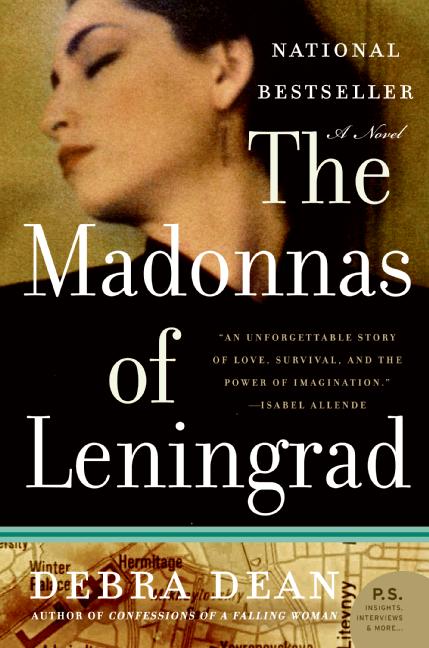
It's rare I take the time to savor a stumbled upon book. With a list of To Be Read that rivals the Eiffel tower in height, I have to be choosy. I was seduced by the vivid cover and compactness of Debra Dean's The Madonnas of Leningrad, and I'm glad for it.
It is not, it must be pointed out, an amazing piece of literature by any common standard. It does, however, offer the quiet pleasure of the picturesque. The story tacks back and forth between the siege of Leningrad and a wedding in Washington state. The reader follows the thoughts and memories of Marina who in her past was a tour guide and art protector at what we now call the Hermitage Museum in Leningrad and who in her present is experiencing the steep downhill of Alzheimer's affliction at her granddaughter's nuptials. What connects the two parts of this woman's life is her relationship to memory.
While suffering from a famine that is killing off the citizens of Leningrad after German bombs wipe out the city's food supply, Marina satisfies her need for pleasure by memorizing what used to be displayed in each room of her museum before the art was shipped off for safe keeping. She remembers the lush still lifes and the pious Madonnas, the stiff portraits and the international curios. Dean's writing, at its best, conveys the semi-hysterical ecstasy that the starving girl feels in the presence of the imagined art works. Each reconstructed brush stroke really does help Marina dull the pain of frozen digits, dying relatives, and a fiance missing on the front.
In her present-day life, Marina is warm and loved by the long-found fiance (now husband) and their two children. She doesn't ache for memories of artistic beauty to fill other needs. This stage of her life is about the (painful, real, harsh, yet ineffably exhilarating, too) truth that forgetting allows one to see beauty too. Marina can no longer identify with accuracy herself in a mirror or her family members around her. This forgetting enables her to disencumber herself of all associations and to just be in the world, to experience the green of a dappled light as though she never has before.
Madonnas is a book to give yourself over to for an afternoon (and that's all it will take). It will bring you on a sweet and short journey into a different life than the one you lead.
Showing posts with label 20th Century Fiction. Show all posts
Monday
Sunday
Reflections: Ragtime
Thirty-five years after its publication, E.L. Doctorow's Ragtime still speaks to readers. It is on the list of "1001 Books You Must Read Before you Die" and was voted one of Time Magazine's best 100 books of the 20th century. Its tale about the American era between the turn of the century and the nation's entry into WWI weaves together concerns and beliefs very much in the fore of American popular discourse today: immigration, capitalism, race relations, patriotism, the gap between the lifestyles of the very rich and the very poor. The scope feels broad, epic even. And for me, at least, this is the book's downfall. It reads like a writing exercise more than a novel, like Doctorow joined a microfiche exploration with a healthy imagination in search of a a plausible story. It only succeeds to a point, and the weakest sections are those least connected to the section of the story that gives the novel its title. In this strand, a black ragtime musician launches a life- unraveling spree of violence after becoming the victim of a vicious act of racism. This part of Doctorow's story, from start to finish, is fascinating, but it loses force of purpose from the penumbra of other stories that lead the reader to constantly try to connect one character to the next. While I try to discern the narrative importance of a luncheon shared by an investor and Henry Ford, the details that would radicalize a young man with a penchant for weapon design slip past, thus making the denouement hardly credible.
The novel begins with a murder: a wealthy sadist has killed the famous architect lover of his opportunistic wife. We are asked to care about this matter because: a> the sadist sees Houdini escape from a cell and later performs the same trick to free himself; b> the architect happened to design some of the buildings in which the action takes place--including the library of Pierpont Morgan; c> the wife, freed by a gunshot from both men with a claim to her finds herself at liberty to pick up with the younger brother of the family that will take in the illegitimate child of the ragtime musician. In the scope of the true core of the narrative, only the younger brother matters. Murder, wife, capitalist, sadistic husband, architect lover, and famous magician: all to no real end. This opening gambit displays the characteristic inefficiency that steers the novel.
Now, one could argue that to focus on plot and its necessary characters and scenes in such a concentrated manner is to take a very narrow view of the art of the novel and of Ragtime in particular. The appearances of Pierpont and Houdini, however tangential they might seem, paint the background of the extraordinary moment in American history in which the action unrolls. You have the great entrepreneurial spirit of Pierpont, with his unparalleled commercial success in all manner of capital ventures. His embarrassment of riches and lack of intellectual competition send him on a spiritual journey to fill his time and his desire for something to truly matter. Boo capitalism. Likewise Houdini seeks the extraordinary (like learning to fly a bi-plane) because these decades are rife with possibility, with arctic adventures and new inventions. But these stories are not presented as background information. In terms of space and depth, the stories of Pierpont and Houdini receive just as much attention as those of anyone else--including the ragtime musician, thus creating a Picasso-esque distortion of perspective.
In short, the novel seems to lack a core, both of focus and of point of view. And while we may take pleasure in the snappy dialogue of Emma Goldman or the plucky spirit of the system-bucking immigrant Tateh, the value of Ragtime as a whole is much less than the sum of its parts.
Reflections: Death Comes for the Archbishop
Few novels manage to maintain the meditative rhythm throughout that Willa Cather's Death Comes for the Archbishop does. Bishop Jean Latour and his longtime companion and spiritual helpmeet Father Joseph Vaillant traverse the New Mexican territory in the wake of the Mexican war (1848) and, eventually, the Gadsden Purchase (1853). Latour and Vaillant commit their lives to serving a long neglected Catholic flock, dispersed as it is across hundreds of miles of desert.
Although we know from the beginning that death will come for the archbishop, this knowledge only provokes us to see more clearly how the potentially mortal harshness of the conditions that the inhabitants of the desert face give rise to a specific kind of life force. Each section of the book focuses on a different brand of spiritual purity, and each lingers over the amazing natural beauty in which it thrives. We see: the loyalty of an Indian guide who will put at risk a tribal secret to save the life of Latour in the midst of a snow storm; the devotion of an old slave who takes advantage of being ousted from a warm house in the clear night of a bitter cold snap to worship at the altar of Mary; the struggle the holy man daily faces between his religious duties and his personal affections made easy under the cleansing solitude produced by desert sand storms; and the power that the light of a sunset cast on the stone of a cathedral can have to revive the spirits of a dying man.
Underneath the reflections on purity, fervor, commitment, and man's place in nature hums a slender but satisfying tale of the sustaining friendship between two men who have left behind their families and country in order to fulfill a mission in which they believe.
Saturday
Reflections: The Man Without Qualities
Considering Robert Musil's The Man Without Qualities (1952, 1978) brings to mind the old schoolyard joke about how being forearmed/four armed is being half an octopus. The reader must allow me at least four arms, and their accompanying hands, to describe this epic novel. It is not a book whose theme one can state simply in a sentence or two.
It is, on one hand, a book about the conflict between romantic idealism and empirical rationality, which considers the effect on the human mind and spirit produced by aristocratic (romantic) versus bureaucratic (empirical) nation state apparatuses. On the/an other hand, it is a novel about the rise of German nationalism in the early twentieth century and the concomitant increase in anti-Semitism. On the metaphorical third hand, it is a fiction about the impossibility of arriving at a true consensus, whether between two lovers, a handful of eminent people, or a nation of citizens. Finally, it is a novel about the terrifying plight of finding yourself without a sufficient attachment to reality to allow you to withstand its constant incursion upon your mental life without suffering mental breakdown. To create in the reader the feeling of this experience, the novel takes as its dizzying project recording the incalculable effort that this life requires. The main character, Ulrich, is as interested in the task as Musil, and he figures that "If all those leaps of attention, flexings of eye muscles, fluctuations of the psyche, if all the effort it takes for a man just to hold himself upright within the flow of traffic on a busy street could be measured…the grand total would surely dwarf the energy needed by Atlas to hold up the world" (7 of the Wilkins, Pike translation). This is certainly how characters like Ulrich, Clarisse (his best friend's mentally unstable wife), and Moosbrugger (a convicted murderer who seems to stand in as a reflection of what Ulrich might have been, given a set of different circumstances) feel, and how the narrative tends, and, I believe, intends, to make the reader feel.
At the center of this philosophical novel is Ulrich, the titular man without qualities. Ulrich's moniker, like everything else in the novel, has multiple and contradictory explanations provided for it. Ulrich wears this label because he does nothing in life and also because he has all of the fine qualities in a man ("He is gifted, open-minded, fearless, tenacious, dashing, circumspect…"), but is not defined by any one of them (62). For the reader, he is a man without qualities in that he is as close to the narrator's idea of the generic citizen produced by the exigencies of the age, but for the novel's characters, that very generic nature causes him to seem extraordinary.
The thread of this novel's story takes up, perhaps, a mere quarter of its pages, while the rest presents (intentionally) inconsistent philosophical reflections on the human spirit. The story, such as it is, can be summarized thus: a capable but directionless young man takes a year's sabbatical to try to reconfigure his life in such a way as to support himself without sacrificing the few ideals that remain to him. His lack of a plan leads him into a job whose main responsibility is to identify the very core of the Austrian character circa 1914. In his dealings with friends, friends of friends, family, friends of family, servants, aristocratic employers, criminals, acquaintances, and would be lovers (of whom there are not a few), he (and Musil) flirts with the obvious conclusion that the empire is too diverse to share common values or goals. The volume draws to a close as Ulrich's campaign not only fails to discover a unifying force, but in fact becomes a force of disunification.
While not a pleasure read, this is a novel to be taken seriously as an examination of the factors that led to a period of simultaneous moral relativism and extremist reaction to that relativism. It is, too, a novel that successfully evokes in the reader the moral confusion from which its characters suffer, and so prohibits one generation's sanctimonious denial of the sins of another.
It is, on one hand, a book about the conflict between romantic idealism and empirical rationality, which considers the effect on the human mind and spirit produced by aristocratic (romantic) versus bureaucratic (empirical) nation state apparatuses. On the/an other hand, it is a novel about the rise of German nationalism in the early twentieth century and the concomitant increase in anti-Semitism. On the metaphorical third hand, it is a fiction about the impossibility of arriving at a true consensus, whether between two lovers, a handful of eminent people, or a nation of citizens. Finally, it is a novel about the terrifying plight of finding yourself without a sufficient attachment to reality to allow you to withstand its constant incursion upon your mental life without suffering mental breakdown. To create in the reader the feeling of this experience, the novel takes as its dizzying project recording the incalculable effort that this life requires. The main character, Ulrich, is as interested in the task as Musil, and he figures that "If all those leaps of attention, flexings of eye muscles, fluctuations of the psyche, if all the effort it takes for a man just to hold himself upright within the flow of traffic on a busy street could be measured…the grand total would surely dwarf the energy needed by Atlas to hold up the world" (7 of the Wilkins, Pike translation). This is certainly how characters like Ulrich, Clarisse (his best friend's mentally unstable wife), and Moosbrugger (a convicted murderer who seems to stand in as a reflection of what Ulrich might have been, given a set of different circumstances) feel, and how the narrative tends, and, I believe, intends, to make the reader feel.
At the center of this philosophical novel is Ulrich, the titular man without qualities. Ulrich's moniker, like everything else in the novel, has multiple and contradictory explanations provided for it. Ulrich wears this label because he does nothing in life and also because he has all of the fine qualities in a man ("He is gifted, open-minded, fearless, tenacious, dashing, circumspect…"), but is not defined by any one of them (62). For the reader, he is a man without qualities in that he is as close to the narrator's idea of the generic citizen produced by the exigencies of the age, but for the novel's characters, that very generic nature causes him to seem extraordinary.
The thread of this novel's story takes up, perhaps, a mere quarter of its pages, while the rest presents (intentionally) inconsistent philosophical reflections on the human spirit. The story, such as it is, can be summarized thus: a capable but directionless young man takes a year's sabbatical to try to reconfigure his life in such a way as to support himself without sacrificing the few ideals that remain to him. His lack of a plan leads him into a job whose main responsibility is to identify the very core of the Austrian character circa 1914. In his dealings with friends, friends of friends, family, friends of family, servants, aristocratic employers, criminals, acquaintances, and would be lovers (of whom there are not a few), he (and Musil) flirts with the obvious conclusion that the empire is too diverse to share common values or goals. The volume draws to a close as Ulrich's campaign not only fails to discover a unifying force, but in fact becomes a force of disunification.
While not a pleasure read, this is a novel to be taken seriously as an examination of the factors that led to a period of simultaneous moral relativism and extremist reaction to that relativism. It is, too, a novel that successfully evokes in the reader the moral confusion from which its characters suffer, and so prohibits one generation's sanctimonious denial of the sins of another.

Subscribe to:
Posts (Atom)