Showing posts with label Reviews. Show all posts

Tuesday

Reflections: A Suitable Boy


Call me Ishmael—or better, Ahab, for I have sought battle with a great, white whale. Some time ago I learned that of the 100 books that an Anglophone reader was most likely to have read, there were four I hadn’t. To be completely average, I would have to read A Suitable Boy by Vikram Seth. I blithely ordered this commonwealth novel (along with the other three titles), and when the box arrived, I feared some mistake. Surely I had not ordered anything of wrought iron with my books—and yet, what else could weigh so much, yet take up so little volume? A Suitable Boy is, in the era of literary compactness, a behemoth at 1,480 pages of low-margin, small print. Yet, I have now read and enjoyed it and would advise others to do the same.

Despite being published in the 1990s, this novel has a nineteenth century feel to it: it’s long, diffuse, weaves in and out of political concerns, and take as its excuse for doing so a basic courtship plot. The setting is India 1951-1952. Gandhi is dead, the country is floundering under the influx of Hindu refugees from the new Pakistan and roiling with religious tensions within its own borders, the first Independent election looms, and yet life for many still centers on the basic milestones of life: getting a husband or job, a baby or a promotion, mourning the dead, praying, eating, drinking, and making merry. Lata Mehra and her friends stand in for the generation of Indians who will become adults in the newly Independent state of India, which, among other things, seeks to give women more and better protections under the law. Lata doubts the intelligence of traditional arranged marriages but is shocked by her best friend’s shameless pursuit of passionate love (including an affair with a married man). She agrees with her mother—who is desperately seeking a suitable boy for her—that soon it will be time to marry. The question is when and to whom.

By a third of the way through the novel, the personnel on the field have become clear. There is handsome and athletic Khalid, with whom Lata sneaks around and shares her first kiss. By her family’s standards, his faith makes him unsuitable, and even Lata doubts the possibility of a happy mixed marriage. Next comes Haresh, an ambitious though uncultured man of her own caste who came to her attention through the traditional channels. Although she won’t agree to a simple meet, greet, and wed, Lata is willing to make his acquaintance and correspond with him to see if she believes they can be compatible. Her mother champions Haresh, while her older brother finds him wanting. Finally, there is Amit, her brother’s brother-in-law. Amit is a Brahmin poet and novelist with whom Lata shares interests. As members of the same large family circle, they freely socialize and discover a great deal in common. One might summarize Lata’s choice thus: she can choose passionate love, a marriage of duty, or a companionate marriage. What gives motivation to the portion of the novel that focuses on this storyline is not who or what she ultimately chooses, but why. Seth draws a fascinating character who is both a product of her traditional culture and a young person seeking the imported ideals of western modernity, with sometimes no clear idea about which of her values or ideas come from where. 

Lata’s story only takes up something like a fifth of the total. In other plots (which I wouldn’t call sub-plots so much as co-plots), a Hindu minister’s son falls desperately in love with a Muslim prostitute-cum-musician with a secret that will bring about death, attempted murder, and political upheaval; a son of wealthy landowners turns socialist and tries to subvert his family’s exploitation; workers strike; festivals become stampedes and riots; politicians balance their ideals, their desires, and the realities of party loyalty.

Each strand of the narration strums a different chord on the instrument of the New India, a complex, brutal, and magical place.    

Monday

Reflections: The Madonnas of Leningrad

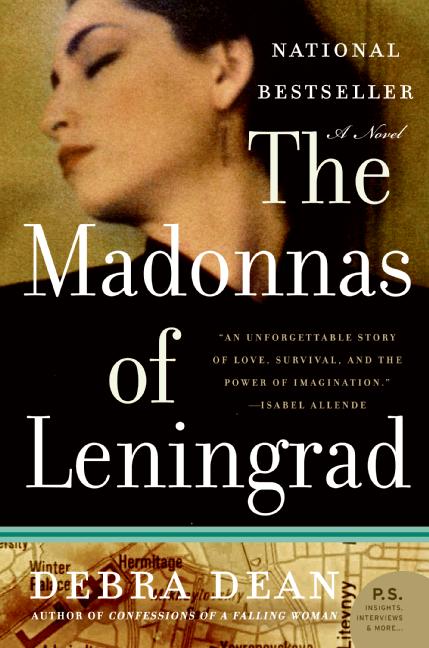
It's rare I take the time to savor  a stumbled upon book. With a list of To Be Read that rivals the Eiffel tower in height, I have to be choosy. I was seduced by the vivid cover and compactness of Debra Dean's The Madonnas of Leningrad, and I'm glad for it.

It is not, it must be pointed out, an amazing piece of literature by any common standard. It does, however, offer the quiet pleasure of the picturesque. The story tacks back and forth between the siege of Leningrad and a wedding in Washington state. The reader follows the thoughts and memories of Marina who in her past was a tour guide and art protector at what we now call the Hermitage Museum in Leningrad and who in her present is experiencing the steep downhill of Alzheimer's affliction at her granddaughter's nuptials. What connects the two parts of this woman's life is her relationship to memory.

While suffering from a famine that is killing off the citizens of Leningrad after German bombs wipe out the city's food supply, Marina satisfies her need for pleasure by memorizing what used to be displayed in each room of her  museum before the art was shipped off for safe keeping. She remembers the lush still lifes and the pious Madonnas, the stiff portraits and the international curios. Dean's writing, at its best, conveys the semi-hysterical ecstasy that the starving girl feels in the presence of the imagined art works. Each reconstructed brush stroke really does help Marina dull the pain of frozen digits, dying relatives, and a fiance missing on the front.

In her present-day life, Marina is warm and loved by the long-found fiance (now husband) and their two children. She doesn't ache for memories of artistic beauty to fill other needs. This stage of her life is about the (painful, real, harsh, yet ineffably exhilarating, too) truth that forgetting allows one to see beauty too. Marina can no longer identify with accuracy herself in a mirror or her family members around her. This forgetting enables her to disencumber herself of all associations and to just be in the world, to experience the green of a dappled light as though she never has before.

Madonnas is a book to give yourself over to for an afternoon (and that's all it will take). It will bring you on a sweet and short journey into a different life than the one you lead.

Sunday

Reflections: Ragtime


Thirty-five years after its publication, E.L. Doctorow's Ragtime still speaks to readers. It is on the list of "1001 Books You Must Read Before you Die" and was voted one of Time Magazine's best 100 books of the 20th century. Its tale about the American era between the turn of the century and the nation's entry into WWI weaves together concerns and beliefs very much in the fore of American popular discourse today: immigration, capitalism, race relations, patriotism, the gap between the lifestyles of the very rich and the very poor. The scope feels broad, epic even. And for me, at least, this is the book's downfall. It reads like a writing exercise more than a novel, like Doctorow joined a microfiche exploration with a healthy imagination in search of a a plausible story. It only succeeds to a point, and the weakest sections are those least connected to the section of the story that gives the novel its title. In this strand, a black ragtime musician launches a life- unraveling spree of violence after becoming the victim of a vicious act of racism. This part of Doctorow's story, from start to finish, is fascinating, but it loses force of purpose from the penumbra of other stories that lead the reader to constantly try to connect one character to the next. While I try to discern the narrative importance of a luncheon shared by an investor and Henry Ford, the details that would radicalize a young man with a penchant for weapon design slip past, thus making the denouement hardly credible.

The novel begins with a murder: a wealthy sadist has killed the famous architect lover of his opportunistic wife. We are asked to care about this matter because: a> the sadist sees Houdini escape from a cell and later performs the same trick to free himself; b> the architect happened to design some of the buildings in which the action takes place--including the library of Pierpont Morgan; c> the wife, freed by a gunshot from both men with a claim to her finds herself at liberty to pick up with the younger brother of the family that will take in the illegitimate child of the ragtime musician. In the scope of the true core of the narrative, only the younger brother matters. Murder, wife, capitalist, sadistic husband, architect lover, and famous magician: all to no real end. This opening gambit displays the characteristic inefficiency that steers the novel.

Now, one could argue that to focus on plot and its necessary characters and scenes in such a concentrated manner is to take a very narrow view of the art of the novel and of Ragtime in particular. The appearances of Pierpont and Houdini, however tangential they might seem, paint the background of the extraordinary moment in American history in which the action unrolls. You have the great entrepreneurial spirit of Pierpont, with his unparalleled commercial success in all manner of capital ventures. His embarrassment of riches and lack of intellectual competition send him on a spiritual journey to fill his time and his desire for something to truly matter. Boo capitalism. Likewise Houdini seeks the extraordinary (like learning to fly a bi-plane) because these decades are rife with possibility, with arctic adventures and new inventions. But these stories are not presented as background information. In terms of space and depth, the stories of Pierpont and Houdini receive just as much attention as those of anyone else--including the ragtime musician, thus creating a Picasso-esque distortion of perspective.

In short, the novel seems to lack a core, both of focus and of point of view. And while we may take pleasure in the snappy dialogue of Emma Goldman or the plucky spirit of the system-bucking immigrant Tateh, the value of Ragtime as a whole is much less than the sum of its parts.

Reflections: The Learners


I was recently reminded just how many ways there are to enjoy fiction. I am a person who holds strong beliefs about what makes a novel a pleasant and worthwhile read. Judged by my code, Chip Kidd's The Learners would not have been at the top of the class. And yet.

I have rarely laughed so hard and so loud in my adult life--and in public too. No social inhibitions could forestall the audible glee of consuming the verbal set pieces and well-written, in-character word play which spill off these pages. To give you just a taste, here is a conversation that introduces to the reader a washed out senior copywriter with whom the narrator works at a New Haven advertising agency:

"Sketch, in a private moment once at Saluzo's after work and feeling a couple thrown back, was..succinct: 'I've always thought of him as a well-wiped asshole.' I had to agree--he certainly was hygienic. Whatever the shambles of his life, there wasn't a hair out of place. Tip even claimed he once caught him in the men's room of the Quinnipiac Club combing his head with a salad fork after a high wind on the croquet lawn blew his comb over to the wrong side. Square of jaw and high of forehead, he looked like an amalgam of Dag Hammarskjold and an Easter Island monolith" (43).

The use of the word 'asshole' as a visual rather than characterological descriptor strikes me as genius. We don't do that. Once the reader had conquered this first dissonance, she must then immediately face another: now that we've turned insult to image, our mental picture must be unmoored from its standard associations--waste, dirtiness. In its place we are asked to understand the clean asshole as somehow cleaner than, say, a freshly cleaned suit.The narrator insists that you follow his lead in morphing the signified, but then, to reward you for good work, he leaves you to the enjoyment of an uncomplicated slapstick moment. We recline on this juvenile humor just long enough to remind ourselves how the pleasure is only superficial and then, wham, to a brain teasing (and absurd) mental image that requires good historical memory (or access to research resources); the Swedish diplomat and Nobel Peace Prize recipient collides with Moai. It's like a hip hop class for your brain.

The above is a small sample of the level of vivid and cheeky description that simultaneously conveys what something looks like and how the narrator feels about it. Perhaps the most artful aspect of this style is its inconsistency: if the whole novel read like this the individual gems would be lost without contrast among their peers. Kidd husbands his comic moments so that each one really zings.

And yet. The novel does leave something to desire; it could almost be described by that great insult of cruisers everywhere: all show, no go. The plot is minimal, the angst that should inhabit that plot somehow mismanaged, and there are ineffective meta-literary insertions that don't add much to the experience--although the last one really carries a significant narrative burden. The Learners has a privileged place on the shelf notwithstanding. Call it beach reading for the unself-consciously geeky.

Thursday

Reflections: Everything Matters!

Novels that reach into experimental territory require an author with a certain talent for persuasion. Readers become accustomed to the norms of fiction and can resent being pushed from their old ways, no matter how good the cause. When I began Everything Matters (2009), by Ron Currie Jr., I felt the narrative Luddite in me raise its head. Why are these paragraphs numbered? How effective is this omniscient narrator and why must he be so different from other omniscient narrators? Am I ready to be directed through a story by (my hypothesis) an alien? And then, the fundamental question, the bright line against which all experimental fiction should, in my view, be judged: will it all be worth it?

In the case of Everything Matters! the answer is a resounding yes. The story wins points for its inventive perspective and its believably fallible characters. The atypical narrative voice was required to make the story stick--to allow for the mixing of genres (post-modern domestic fiction and science fiction) without the final product being a malformed example of either one. When the genre of a novel cannot be determined but the story is compelling, there you have, in this reader's view, the height of the literary art. People like me read expressly to find these gems.

For those unwilling to be convinced to go out and request this book from their local library without a better sense of what it is about, read on. Everything Matters! poses the question, how would knowledge of an impending apocalypse shape a human's mind and development?  As a fetus, Junior Thibodeau receives advice and information from a mysterious source. When Junior makes his heavy way into the world, he learns that the trials of birth have been only the first of many challenges that are to come. Among the many bits of information conveyed to the infant is that the world will end in approximately 36 years. Saddled with this knowledge and an uncanny ability to know things beyond his years and experience, Junior must face the normal difficulties of growing up in America from the perspective of one who knows that nothing really matters. Or so he thinks. Things look a little different when the thirty six years have passed and he gets one last message from his communicative spirit.

Sunday

Reflections: The Bee Season


At the core of Myla Goldberg's Bee Season is the principle that true enlightenment means making your own choices despite the will of others. Young Eliza Naumann is an example of a new generation of Jewish Americans, the product of a father who broke with his secular and wholly assimilated family to become a Torah scholar and cantor. Eliza has no such deep connection to her roots, and this is the source of the novel's central tension. She cannot look to the past to find strength, but has a parent whose only source of strength is in his nostalgic rehabilitation of genealogical and mythic history.

Over the course of the story Eliza, a would-be spelling bee champion, experiences two moments of enlightenment, one false and the other genuine. Her false enlightenment stems from a dependence upon her father and his religious training to shape her raw talent. When her father takes her talent in spelling and interprets it as a sign of a special connection to God, he leads her into an improperly motivated quest for Shefa, or enlightenment. Eliza enthusiastically goes along with his study plan because she is so starved for the love and attention he has been showering on her older brother for as long as she can remember. The desire to be special, to win the spelling bee and her father's love, leads her to compulsively practice the mystic lessons her father teaches her.

Her intense commitment to a project not her own leads Eliza to send herself into a spiritual fit with very real physical manifestations. Goldberg paints the outcome in this moment of terror and pain as a moment of rebirth. The pain she experiences is "the pain of creation, of life emerging from void, of vacuum birthing being" (270). The vacuum of her life under the influence of ancient Jewish texts gives rise to the "being" of the individual who will choose her own guiding texts and ideas. In her newborn state, Eliza throws her next spelling bee, removing herself from the competition and the smothering effects of her father's will. Given the opportunity to recant the misspelling, and, by extension, her choice to go her own way, Eliza reaffirms her choice with a nod. The final sentence of the novel underlines the message: "She is sure" (274). What Eliza is sure of is that the attachment to mythic Jewish roots that created her father's identity will only bring her to destruction. According to this text, cultural nostalgia no longer serves the needs of young Jewish Americans.

Friday

Reflections: In the Country of Last Things

Paul Auster's 1987 novella, In the Country of Last Things, shows the power that language can have to create whole new worlds for the reader to experience. Auster truly deserves the encomia heaped upon him, for he has mastered the art of prose fiction.

Our narrator, Anna Blume, has slipped across the border into an urban space that used to be like our own, but has experienced some inexplicable blight. Everything has broken down, from government services (except, tellingly, the daily collection of dead bodies) and protections to basic codes of civility, man's instinctual desire for survival, and even biological systems of individuals. The gruesome imagined world allows Auster to paint the latent selfishness we all carry with us, and how it rises to the surface in savage circumstances. In that respect, it shares its technique with  the most moving of novels about war and natural disaster. However, because the cause of this barbarism is unknown, the focus homes in not on the politics of societies but on the actions of individuals that contribute to the overall degradation.

Anna maintains her will to live, and her instincts to do so, by crafting temporary communities to which she can commit. She sacrifices her own safety to save an elderly woman on the street, and then makes that woman into a surrogate mother figure with whom she lives and to whom she dedicates her energies and resources. Once the woman dies, she spends her last funds on an extravagent act of mourning, and goes out to look for death or another community. Tracking Anna's mood and health to her ability to create a common  cause with others, Auster underscores that the sacrifices that we make in the development of relationships to be, finally, investments in our own endurance.

Within the context of Anna's life, writing is the other saving grace, and even this is social. Her narrative addresses an old friend from outside the country of last things, explaining to him the physical and social landscape in which she finds herself doomed to pass the rest of her days. As such, the story reminds us what dedicated readers sometimes fail to adequately consider: why we read. Communities, especially in the modern world, pop up in ways beyond the physical, and writing can be our greatest tool to draw people together for our collective survival.

Saturday

Reflections: Chaos: A Novella and Stories

Reading Edmund White's Chaos: A Novella and Stories means experiencing delicious doubt: is this fiction or fictionalized? That one cannot tell is a tribute to just how talented White is as an observer of character; the short narratives craft such full and believable characters that one cannot imagine how White could have created them out of whole cloth. Each of the four pieces reports the ornate inner lives of, in the main, aging gay men. Each sings with--in lesser or greater degree--White's pleasurably cultured prose.

Versions of how men confront aging define the collection. The novella "Chaos" tells the story of an older author's gradual winding down of his profession and his life-long relationships. The novella ornaments its gray-toned narrative with wit, most notable in Jack's half-loving, half-mocking descriptions of a younger generation of gay men whose values and foibles differ from that of his own earlier years, and who he finds repulsive in the aggregate yet compelling as individuals. The final story, "A Good Sport," also explores the life of an aging gay man in retirement. The narrator, unlike Jack, accepts his fading sex life more calmly, sinking his energies into an old friendship and an opium-induced fantasy, part historical fiction, part the male equivalent of a bodice-ripper.

Because White's talent lies in quietly revealing the quirks of character developed over lifetimes of experience, his skills are better adapted to the mid-length "Chaos" than to the shorter pieces. These latter rarely incite the reader's engagement. On a sentence to sentence level, White is a master. From page to page, however, he is rather more uneven.

Wednesday

Reflections: The Children's Book


A narrative, a history lesson, a treatise on the material culture of Europe before WWI, a reflection on the various burdens of the woman's condition: A.S. Byatt's The Children's Book defies a basic generic descriptor. For whatever else it may be, it is a surprisingly long novel in the contemporary market, and quite an ambitious one at that.

The novel takes place in England, and spans the years between the establishment of the Fabian Society and the end of the first World War. It casts its net over a broad cast of characters, from the working class potter Philip and his sister Elsie to a German puppeteer to an egocentric author of children's literature, Olive Wellwood, and her unconventional family. Like the fairy tales of Olive (and of most good children's fiction writers), Byatt's world is peopled by adults who are largely unimportant except insofar as their actions, beliefs, ambitions, and interests shape the generation of children who celebrate Midsummer's Eve in 1895. It is a generation that grows with the promise of equality among the classes, better opportunities for women, and more sexual freedom than the Victorian era had afforded. It is a generation that crumbles under the pressure of failed social movements and unspeakable violence in the trenches of Europe.


To recount the particular actions of individual characters would be to miss the point. In fact, when Byatt goes wrong, it is by getting too particular (usually in a way either unbelievable or mawkishly sentimental) with the telling of her characters' lives. At no point do any of them stand out as fully-developed subjects. Rather, they each stand in for a way of life peculiarly open to this particular generation. The personages of the story come in and out of the reader's awareness, briefly personifying a dilemma, a freedom, or a theory that shaped the age.The broad cast buoys up this unique narrative style, and successfully creates the era itself as the protagonist--a not unimpressive feat.


Byatt's vision of an era alternatively propelled by the mystical  or the Utopian and the supremely practical is impressive. It is occasionally marred, however, with the sudden narration of unrelated historical facts, or with a ham-fisted psychologizing of these characters otherwise defined for the reader through action. The useless insertion of incest and suicide suggest a grasped at, and missed, profundity in the creation of a character. Worse, these moments, for a short time, destroy the truly interesting creation of the collective psychology that is this novel's real innovation. Although not perfect, The Children's Book has a great deal to offer.

Sunday

Reflections: The Echo Maker

Richard Powers brings his audience another idea novel in The Echo Maker (2006). This "neuro-novel" plumbs the depths of a small handful of characters, seemingly to prove the point that all sense of self derives from the human brain's tendency to create a continuous and logical narrative about who we are and what we are doing in the world. In other words, Powers frets, biochemical impulses are all that give us what we prize most: our sense of unique identity.

Mark Schluter suffers a serious head trauma in a late night accident on a country road. The result is, among other things, Capgras syndrome: a neurological disorder that causes the sufferer to believe that a beloved person or object has been replaced by an identical double. In this case, Mark thinks that his sister and his dog have been replaced by doubles. Once he believes this to be so (due to a simple misfiring in the brain's recognition processes), his mind must construct a narrative to explain why this would be so; clearly he has become part of a government conspiracy that has made it needful for him to be removed from his normal surroundings.

Karin, devastated by being unrecognized and unthanked for her relentless care of Mark as he recovers, sets out to find an expert who can cure him. Enter Gerald Weber, a crypto-Oliver Sacks. Mark's recovery comes for Weber a kind of rehabilitation; he realizes at the sunset of his career that he has been taking advantage of the patients whose stories he has been using to build his recognition as a famous neuro-psychologist. Seeking redemption, he does something he seems not to have done in the past: he finds a solution.

Mark, Karin, and their hometown compatriots present a not inaccurate portrait of rural America, from the  knee-jerk patriotism to the close connection to the land to the charming and odd autodidacticism particular to the culture. Had Powers stuck with this cast he would have presented a richer representation of his sotry. Gerald Weber's psychic breakdown and its predictable attachment to sex with a younger woman banalizes the common but shocking experience that everyone feels when recognizing that our sense of identity is nothing but a story we tell ourselves to put one foot in front of the other from day to day. Despite its interesting topic and an artfully drawn community, The Echo Maker is too ambitious for its own good and comes off as pretentious rather than powerful.

Reflections: Gentlemen of the Road


Michael Chabon knows narrative. He knows male/male friendship bonds. He knows modern American Jewish culture. In Gentlemen of the Road he brings them all together...again. As in The Adventures of Kavalier and Clay, Chabon has mixed together his essential ingredients to come up with a new and exciting recipe for the reader's delectation.

Gentlemen keeps its eyes upon two highwaymen of the Sherwood Forest type. Zelikman and Amram wander the roads of medieval Asia, doing what it takes to make ends meet. Like other mythical highwaymen (and comic book characters) these two are ennobled by conscience. Furthermore, they are pleasantly infallible with the use of blades and axes, horses and hats. Along the road, performing their usual con routine, they stumble into the possession/company of a royal and fiery youth, in exile due to a coup d'etat that has left the teen friendless and hunted, but not without inner resources. Their sense of justice leads them, on something other than the straight and narrow path, to champion the royal cause.

Tuesday

Reflections: White Noise

Don Delillo's White Noise (1985) is, for all of its post-modern pretensions, a domestic novel. It begins with a father, satisfied in his career, watching benignly as other families--more kempt and wealthy than his own, yet familiar and appealing to him--descend onto his territory, the campus on the Hill. The story, such as it is, expresses the turmoils of its adult main characters, Jack and Babette, through their attachment to their peculiar and yet shockingly real children. Even when the end takes a turn for the violent, and Jack finds himself standing in front of a man he has just shot, the overall genre doesn't change. Jack's humanity neutralizes his jealousy, and turns the moment from hard boiled to Hallmark. Then, Jack's stubborn and dangerous plan is replicated in miniature when his youngest child sets out, stubbornly, on a dangerous mission of his own. The child, like Jack, escapes relatively unharmed, and is in fine form for their next joint trip to the purveyor of American domestic life: the supermarket. Its reorganization induces more trauma than Jack's brief stint as a would-be murderer. From start to finish, White Noise celebrates the modern nuclear family unit, in all of its messiness.

 Amidst the hubbub of family, White Noise satirizes the American schizophrenia towards chemicals: in a hanging cloud, they are the cause of death. In small white, well-engineered pills, they are the solution to, if not death, at least man's fear of it. None of the characters except Jack's colleague, Murray, can really grasp that death is a natural phenomenon, as is man's fear of it. Unfortunately, the satire exists more in tone than content, thus putting Delillo at risk of the same criticisms as Jack, who invented Hitler Studies by, it seems, gaining weight and wearing sunglasses. Delillo's insights seem as Jack's: questionable in authority as he doesn't really speak the language.

While an interesting and entertaining read, rendered almost necessary by the long-standing cultural importance of Don Delillo, the novel wears on one. Simply put: it tries too hard. Like its characters, it mistakes surface for substance.

Friday

Reflections: Balzac and the Little Chinese Seamstress


Dai Sijie's novella Balzac and the Little Chinese Seamstress holds out the promise latent in all acclaimed and slender works of fiction. There is an excitement specific to contemporary medium length fiction, which causes hopes of spare, elegant, and often experimental prose to dance in one's head. Form aside, here is a romantic story of love and friendship in the midst of an important historical moment.

Luo and his peer Ma, our narrator, bear the perceived sins of their professional parents and so are sent to a rural town to participate in communal labor and be "reeducated" in the agrarian ideal so dear to Mao's heart. They suffer the physical dangers and annoyances of the primitive society in which they sojourn, forced to carry human and animal waste on their backs to fertilize the fields, to work naked in locally run coal mines, and to brave the risks of malarial air. They are saved from complete depression by the tokens of urban culture they are able to retain: Ma's violin, an alarm clock, and a hunger for a good story. Then, they meet the little seamstress, and, with the help of a stock of banned books, become the purveyors of their own reeducation program, focusing their youthful energy on changing a beautiful mountain girl into their educated female ideal.


Although built around the interesting question of what happens when fully indoctrinated children of the Cultural Revolution first ingest western ideas devoid of their social context, Balzac fails to involve the reader in the sudden self-realization of the three young protagonists. The problem seems to lie in a wavering of purpose: is the goal to detail the experiences of the generation of Chinese coming of age in Mao's rural re-education program, or to define the effect that foreign literature can have on fecund minds regardless of material and historical context? Is this a love story or a story about trench friendships arising in difficult circumstances? It is in some respect all of these, but in the most important respect, none.

Monday

Reflections: Come Together, Fall Apart


Cristina Henriquez has been hailed as a writer to watch. Her 2006 collection of short fiction Come Together, Fall Apart brings to life both the Panama that existed on the eve of Noriega's capture and that which exists today.

What follows refers only to the novella "Come Together, Fall Apart" within the collection of the same name.

The reader of  "Come Together, Fall Apart" experiences the months leading up to the US invasion of Panama through the journal of young Ramon. This adolescent falls in love for the first time while his family and country disintegrate around him. Appropriate to the age of the narrator, the emphasis on, and importance of, political and personal events seems out of balance; Ramon's uncertain steps into the arena of romance and petty theft naturally weigh more heavily on his mind than the change of home forced on his family or than the casualties taking place on the streets around him as car bombs detonate and random acts of violence occur.

For all of "Come Together, Fall Apart"'s inherent interest as a record of a historical moment, its real power lies in the description of a singular nuclear family and its misapprehension by those who see it, however intimately, from the outside. Ramon's mother and father are each originals in the best sense of the word, and they are held together by a bond that remains understated but unmistakable. The father exudes a gentleness and moral character that shape Ramon into the simultaneously tentative and commanding voice of the narrative. The mother's superstitious--almost mystical-- relationship to the world haunts the reader as she shies from the stresses of daily life under pressure of the invasion, but then finds the strength to make a quick, irrevocable and wrenching decision when demanded of her.

This fiction exudes none of the artful concision and focus that one expects from short fiction. It draws out unnecessary detail and imposes no order upon its tale. And yet, it is a story both creative and poignant.

Sunday

Reflections: Death Comes for the Archbishop


Few novels manage to maintain the meditative rhythm throughout that Willa Cather's Death Comes for the Archbishop does. Bishop Jean Latour and his longtime companion and spiritual helpmeet Father Joseph Vaillant traverse the New Mexican territory in the wake of the Mexican war (1848) and, eventually, the Gadsden Purchase (1853). Latour and  Vaillant commit their lives to serving a long neglected Catholic flock, dispersed as it is across hundreds of miles of desert.

Although we know from the beginning that death will come for the archbishop, this knowledge only provokes us to see more clearly how the potentially mortal harshness of the conditions that the inhabitants of the desert face give rise to a specific kind of life force. Each section of the book focuses on a different brand of spiritual purity, and each lingers over the amazing natural beauty in which it thrives. We see: the loyalty of an Indian guide who will put at risk a tribal secret to save the life of Latour in the midst of a snow storm; the devotion of an old slave who takes advantage of being ousted from a warm house in the clear night of a bitter cold snap to worship at the altar of Mary; the struggle the holy man daily faces between his religious duties and his personal affections made easy under the cleansing solitude produced by desert sand storms; and the power that the light of a sunset cast on the stone of a cathedral can have to revive the spirits of a dying man.

Underneath the reflections on purity, fervor, commitment, and man's place in nature hums a slender but satisfying tale of the sustaining friendship between two men who have left behind their families and country in order to fulfill a mission in which they believe.

Saturday

Reflections: The Grandissimes

In the years 1803 and 1804, Louisiana confronted a crisis of identity when its western portion, including New Orleans, became part of the United States through the Louisiana Purchase. In the months and years following the purchase, the region's citizens and slaves confronted a challenge to their social arrangements, rights, beliefs and traditions. A single question was on everyone's mind: could an act of political exchange between nations change their loyalties and make them into Americans? This is the moment which George Washington Cable describes in his romantic, well-paced novel, The Grandissimes (1880).

This novel focuses on New Orleans largely through the perspective of an outsider in a place that abhors the alien. Frowenfeld, a bookish German-American, emigrates with his family to Louisiana. Almost immediately, they are all struck down by the fever, and he must make his way alone. While for most the fact that he isn't local make him a symbol of the encroaching Yankee, others recognize him as a source for insight into a social system in crisis. He becomes a kind of translator among the powerful people in each strata of the city's world. As he takes his first steps in establishing himself in this new land, he befriends the powerful Honore de Grandissime, the scion of the oldest and wealthiest local family who bears on his shoulders the responsibility for protecting and managing a hoard of stubborn but helpless relatives. For Honore and others, Frowenfeld acts as a conscience, questioning and undermining the assumption that tradition trumps morality with regards to money and racial equality. Over time, Frowenfeld's advice will lead Honore into partnership with his older quadroon half-brother, also named Honore de Grandissime. This partnership severs the younger Honore from parts of his family, and yet at the same time, it weakens the beliefs upholding the region's racialized oppression.

It may seem questionable to attribute a lightness of touch to a novel that dares to use the literary device of having two men with the same name. And yet, the fact that Cable does just this and turns it from a cheap gimmick to a simple matter of fact in his represented world speaks to what makes him an important figure in American literature: he has a literary instinct more refined than his nineteenth-century counterparts. His art touches each step of plotting and description, allowing him to describe a world riddled with moral complexities and regional oddities without privileging his message over his story. It is perhaps for this reason that although The Grandissimes gives significantly more attention to the history and experiences of plantation slaves, it is the later work of Twain that has become the classic text for analyzing the race relations in antebellum America.

Reflections: The Body Artist

The Body Artist (2001), by Don DeLillo, falls into the peculiar genre of the "short novel" alongside works like The Stranger and Of Mice and Men. Short novels beg to be considered on different terms than longer pieces; they are often engaged in a hyper-focused description of one particular event or experience. In a longer novel, this would be precious or over-bearing, but in short fiction it is a kind of art: the micro-biology of the literary, if you will.

DeLillo here focuses on the intense mental anxiety produced when we confront the inexplicable. Lauren, the body artist, first faces the odd circumstances surrounding her husband's death and then the appearance of Mr. Tuttle, the name Lauren gives to a man child of unknown provenance who she discovers camping out in her home. Tuttle is incapable of creating comprehensible utterances but can reprise those he's heard before with eerie accuracy. In the rambling house that she has rented, she shares a space with her husband's ghost and the imitative Mr. Tuttle who brings his voice and gesticulations back to her at unpredictable intervals.

Lauren's response to the emotional challenges she faces is to rehearse them publicly in her professional role as a performance artist. Baffling her audience, she reenacts the odd occurrences of her life. In this regard she shares more than one might think with her Mr. Tuttle, putting on a show that aims to create human connection about abnormal events while simply underlining its impossibility.


Focusing in such detail on the odd events in Lauren's life and the strange mind that receives and processes them requires a narrative language far from ordinary. To recount the story of Lauren's coping requires, from the start, a language of its own that denies the order inherent in grammar and accepted nomenclature. The narrative voice sings a kind of poetry that walks a line between the now less than shocking language of stream of consciousness and an imagined representation of what mentalese would sound like if, paradoxically, it were put into words.

Friday

Reflections: The Amazing Adventures of Kavalier and Clay

Michael Chabon's novel The Amazing Adventures of Kavalier and Clay is one for the ages. It's a rare novel that inhabits an impressive concept, brings painfully full characters to life, contributes well-crafted observations to the cultural vault, and entertains you with a gripping story throughout. This Chabon has effected with a style and grace that make the true lover of literary fiction ache with a combination of nostalgia, ambition, and wrenching pleasure as she reads the last lines and resigns herself to no longer having the novel as her daily companion. Do I wax ecstatic? In penance I will pull myself back to the hard earth of facts.

Chabon chronicles the story of Samuel Clay and Josef Kavalier, Jewish cousins growing into adulthood on the eve of Hitler's devastation of the old Europe. Sam's mother unceremoniously demands one evening that her son, a comic-book loving Brooklynite, shove over to make room in his bed for his hitherto unknown cousin Josef, who has just escaped from Prague in a coffin with a Golem. Sammy shares his bed that night, and the next morning becomes Josef's guide into American popular culture via the new media of the comic book. In an impressive act of hustling, the boys leap from being poor, aimless young men and strangers to one another, to being one of the nation's top-selling comic artist teams and one another's primary personal relationship.

For all of their intimacy and mutual understanding, they are separated by Joe's status as the saved son, who scrambles to succeed in this new land in order to rescue his family from the terrors prepared for them by Hitler's Reich. This mission is understood and supported by Sam, but it simply cannot be experienced by him, and this difference will drive a wedge between them and corrode the happiness of each man and the people who love him.

Saturday

Reflections: The Man Without Qualities


Considering Robert Musil's The Man Without Qualities (1952, 1978) brings to mind the old schoolyard joke about how being forearmed/four armed is being half an octopus. The reader must allow me at least four arms, and their accompanying hands, to describe this epic novel. It is not a book whose theme one can state simply in a sentence or two.

It is, on one hand, a book about the conflict between romantic idealism and empirical rationality, which considers the effect on the human mind and spirit produced by aristocratic (romantic) versus bureaucratic (empirical) nation state apparatuses. On the/an other hand, it is a novel about the rise of German nationalism in the early twentieth century and the concomitant increase in anti-Semitism. On the metaphorical third hand, it is a fiction about the impossibility of arriving at a true consensus, whether between two lovers, a handful of eminent people, or a nation of citizens. Finally, it is a novel about the terrifying plight of finding yourself without a sufficient attachment to reality to allow you to withstand its constant incursion upon your mental life without suffering mental breakdown. To create in the reader the feeling of this experience, the novel takes as its dizzying project recording the incalculable effort that this life requires. The main character, Ulrich, is as interested in the task as Musil, and he figures that "If all those leaps of attention, flexings of eye muscles, fluctuations of the psyche, if all the effort it takes for a man just to hold himself upright within the flow of traffic on a busy street could be measured…the grand total would surely dwarf the energy needed by Atlas to hold up the world" (7 of the Wilkins, Pike translation). This is certainly how characters like Ulrich, Clarisse (his best friend's mentally unstable wife), and Moosbrugger (a convicted murderer who seems to stand in as a reflection of what Ulrich might have been, given a set of different circumstances) feel, and how the narrative tends, and, I believe, intends, to make the reader feel.

At the center of this philosophical novel is Ulrich, the titular man without qualities. Ulrich's moniker, like everything else in the novel, has multiple and contradictory explanations provided for it. Ulrich wears this label because he does nothing in life and also because he has all of the fine qualities in a man ("He is gifted, open-minded, fearless, tenacious, dashing, circumspect…"), but is not defined by any one of them (62). For the reader, he is a man without qualities in that he is as close to the narrator's idea of the generic citizen produced by the exigencies of the age, but for the novel's characters, that very generic nature causes him to seem extraordinary.

The thread of this novel's story takes up, perhaps, a mere quarter of its pages, while the rest presents (intentionally) inconsistent philosophical reflections on the human spirit. The story, such as it is, can be summarized thus: a capable but directionless young man takes a year's sabbatical to try to reconfigure his life in such a way as to support himself without sacrificing the few ideals that remain to him. His lack of a plan leads him into a job whose main responsibility is to identify the very core of the Austrian character circa 1914. In his dealings with friends, friends of friends, family, friends of family, servants, aristocratic employers, criminals, acquaintances, and would be lovers (of whom there are not a few), he (and Musil) flirts with the obvious conclusion that the empire is too diverse to share common values or goals. The volume draws to a close as Ulrich's campaign not only fails to discover a unifying force, but in fact becomes a force of disunification.

While not a pleasure read, this is a novel to be taken seriously as an examination of the factors that led to a period of simultaneous moral relativism and extremist reaction to that relativism. It is, too, a novel that successfully evokes in the reader the moral confusion from which its characters suffer, and so prohibits one generation's sanctimonious denial of the sins of another.

Reflections: Shroud


Samuel Johnson once crafted a simultaneously admiring and damning summation of the work of novelist Samuel Richardson with this statement: "[i]f you were to read Richardson for the story, your impatience would be so much fretted that you would hang yourself. But you must read him for the sentiment, and consider the story as only giving occasion to the sentiment." Replace "Richardson" with Banville" and both "sentiment"s with "characterization" and you have a relatively fair assessment of John Banville's Shroud (2002).

Shroud places two odd personages in explosive proximity and then steps back to see what happens. Cass Cleave, a mentally unstable young woman with an Electra complex, provokes a meeting with an ancient, narcissistic academic whom she has discovered to have underhandedly taken on  the pseudonym Axel Vander in his late adolescence. Cleave's lack of clarity regarding what she would like to accomplish with the encounter finds its parallel in the story's uncertainty about what exactly it proposes to do with the reader it has invited into its pages.

As improbable as it may sound given the description above, Shroud might best be described as a love story. "Vander" watches his body decay and finds little to comfort him in his long-held, militant disbelief in inherent individuality. What he therefore allows himself to discover, in Cass and in retrospective consideration of his past affairs, is that despite what philosophers might posit about the unimportance of the self, the strange human habit of loving and coupling provides a constant, insistent rebuttal.